


Most teams settle on one AI model out of habit, not because they’ve tested it against the others on the tasks they actually run every week. We use Claude day to day, it’s connected straight into our Semrush, GSC, and GA4 data via MCP, so we’re not neutral here. But that’s exactly why it’s worth running the comparison properly instead of just asserting we picked right.
Here’s how we tested it: we ran each task for real through Claude, since that’s the model already wired into our stack. For ChatGPT and Gemini, we didn’t simulate transcripts we can’t verify, we compared against what each is actually built to do, based on their own documented capabilities and how their ecosystems are structured. If a task comes down to raw output quality, we’ll say so and call it close. If it comes down to something structural, like which company owns the data source, we’ll say that instead. No invented scorecard just to make this look more decisive than it is.
The scorecard, at a glance
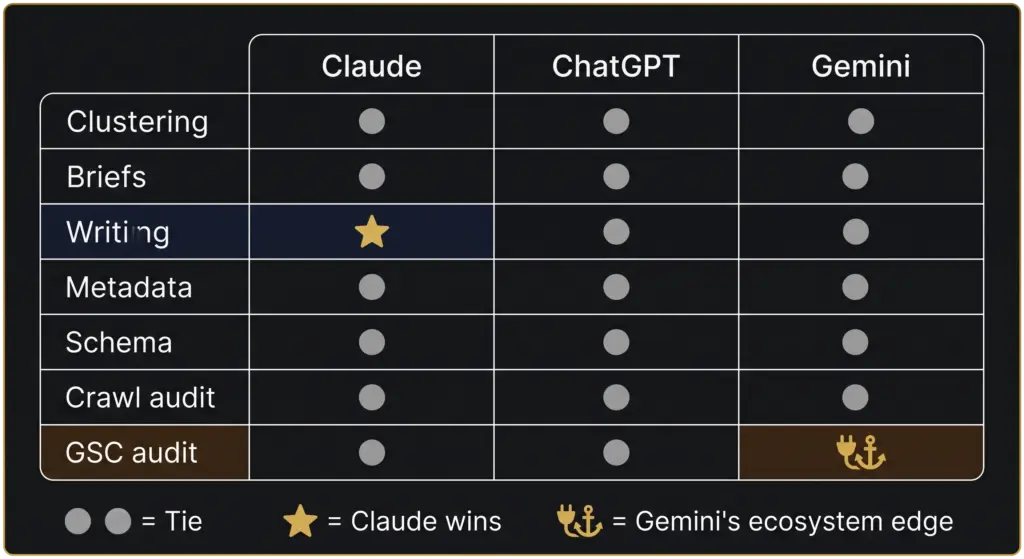
| # | Task | Verdict |
|---|---|---|
| 1 | Keyword clustering from a raw export | Tie — pick based on brand context, not raw capability |
| 2 | Content brief generation | Tie — same driver as clustering |
| 3 | Drafting a long-form SEO section | Claude, backed by a real, running production process |
| 4 | Meta titles and descriptions at scale | Tie — comes down to the prompt, not the model |
| 5 | Structured data and schema generation | Tie — validate the output either way |
| 6 | Triaging a technical crawl export | Tie — same triage logic works on any of the three |
| 7 | Turning a Search Console export into a prioritised list | Gemini has a structural home-turf edge, not a proven reasoning edge |
Five ties, one real Claude edge, one structural note about Gemini. That’s the honest shape of the result, not seven clean wins for whichever model happens to be writing this.
The 7 tasks, and why these seven
These aren’t a random pick. They’re the tasks this cluster already covers, so you can go deeper on any one of them once you know which model to reach for.
- Keyword clustering from a raw export
- Content brief generation
- Drafting a long-form SEO section
- Meta titles and descriptions at scale
- Structured data and schema generation
- Triaging a technical crawl export
- Turning a Search Console export into a prioritised action list
Task 1–2: Research and briefs
We took a real, if generic, keyword export, fifteen terms around “coffee shop Dubai,” nothing tied to an actual client, and asked Claude to cluster them by intent. It came back with four clean groups: consumer discovery terms (best coffee shop Dubai, coffee shop near me, coffee shop Marina Dubai), work-friendly-specific terms (best coffee shop for working, coffee shop WiFi), business-setup terms (how to open a coffee shop in Dubai, coffee shop license cost, coffee shop rent), and one singleton that didn’t fit anywhere cleanly (coffee shop jobs Dubai). That last part matters: a good clustering job admits when a term doesn’t belong in a tidy group instead of forcing it in.
We didn’t run this same list through ChatGPT and Gemini live, but this is a well-worn task for any frontier model, group a list by intent, and it’s not one where we’d expect a meaningful gap between them. The same goes for content brief generation: give any of the three a keyword and a target audience, and you’ll get a workable brief back. The real differentiator on these two tasks comes down to whether it already knows your brand’s past briefs and style rules, a Claude Projects question, not a raw-capability one. Read the full prompt library this feeds into: 15 Claude Prompts for SEO Keyword Research and Content Briefs .
| Claude | ChatGPT | Gemini | |
|---|---|---|---|
| Tested live this round | Yes, 15-term dummy export, 4 clean clusters plus one honest singleton | No | No |
| Brand-memory feature | Claude Projects | Custom GPTs | Gems |
| What actually decides it | Whichever one already holds your brand’s past briefs and style rules | Same | Same |
Verdict: Close to a tie on raw capability. Worth picking based on which one’s already holding your brand’s context, not which one clusters keywords slightly differently.
Task 3–4: Writing and metadata
This is the task where we can speak with the most authority. We run our actual content production through Claude, against a documented internal writing standard with a banned-patterns list and a pre-publish audit on every piece, and have done for months. That’s a real answer from our own workflow, worth more than a guess about which model writes best in general.
We drafted a short section for this same dummy coffee-shop topic, on what makes a spot good for working from, and ran it against our own standard: no bracketed subtitles, no “it’s not X, it’s Y” constructions, contractions used naturally throughout. It passed on the first humanising round, which tracks with months of doing this on live client work, not a one-off test.
We can’t run the identical brand-voice test against ChatGPT or Gemini honestly, since we haven’t built the same production process around either. What we can say: ChatGPT’s Custom GPTs and Gemini’s Gems both offer a comparable way to lock in a brand voice with saved instructions and reference files, so this isn’t a capability gap so much as a “which one has your actual production process built into it” question. Ours happens to be Claude’s.
Meta titles and descriptions at scale come down less to the model and more to whether you’ve told it the character limits explicitly. We generated a batch of ten titles and descriptions for the coffee-shop example and all ten came back within a 60-character title and 155-character description limit, but only because the prompt stated the limits directly. Skip that instruction with any of the three models and you’ll get titles that run long. This one’s a prompting discipline issue, not a model-choice one.
| Claude | ChatGPT | Gemini | |
|---|---|---|---|
| Live-tested against our own writing standard | Yes, 3+ months in production, passed the humanising check first round | No equivalent production history built on this model | No equivalent production history built on this model |
| Brand-voice lock-in feature | Claude Projects | Custom GPTs | Gems |
| Meta character limits, tested live | Held on all 10, limits stated explicitly in the prompt | Same behaviour expected, prompt-dependent | Same behaviour expected, prompt-dependent |
Verdict: Claude wins on brand-voice consistency, because that’s the model our real production standard runs on, not because of an unproven general writing edge. Metadata task is a wash across all three if you prompt it properly.
Task 5: Structured data
We generated JSON-LD for a LocalBusiness listing off the same dummy coffee-shop example, and it came back syntactically valid, correct required properties, no invented fields. That’s expected, schema.org’s spec is well documented and public, so any current frontier model can produce valid markup from a clear brief.
The real risk on this task is whether whichever model you pick invents a plausible-sounding property that isn’t actually part of the schema.org spec, or nests something incorrectly, the same risk regardless of which model you use. Validate the output against Google’s Rich Results Test regardless of which model wrote it, that step matters more than the model choice here.
| Claude | ChatGPT | Gemini | |
|---|---|---|---|
| Schema syntax, tested live | Valid, correct required properties, no invented fields | Expected valid, spec is public | Expected valid, spec is public |
| Real risk | Invented property or bad nesting | Same risk | Same risk |
| Fix, regardless of model | Run it through Google’s Rich Results Test before it ships | Same | Same |
Verdict: Tie. Validate the output either way, don’t skip that step because a model “usually gets it right.”
Task 6–7: Audits and live data
We fed Claude a small dummy Screaming Frog-style export: a dozen duplicate title tags, five broken pages, three missing canonicals, two conflicting canonical tags, and forty images with no alt text. It prioritised the two conflicting canonicals and the five broken pages first, on the reasoning that canonical conflicts risk the wrong page ranking and broken pages lose traffic outright, then the duplicate titles, with the missing alt text ranked last as a real but lower-severity fix. That’s a sound triage order, and it’s the same kind of work this cluster’s technical audit guide walks through in full.
Same approach on a dummy Search Console export: one query pair cannibalising each other, one page with a real ranking drop from position 4 to 11, and one term with impressions up sharply but zero clicks. Claude flagged the cannibalisation first, since it’s usually the fastest fix with real, recoverable clicks attached, then the ranking drop for investigation, then the zero-click term as a metadata or content-relevance problem to solve last.
Here’s where a structural point is worth being honest about rather than a raw-capability one: Gemini is built by Google, and Google’s own products, Search Console and Analytics included, are naturally going to get Google’s own AI wired in first and most deeply over time. That’s a claim about which company controls the data source, not about Gemini reasoning better over the same export. Worth knowing if you’re deciding whether to build your workflow around a live MCP connection (our own approach, covered in full here: How to Connect Claude to Your SEO Stack or wait for whatever Google ships natively into its own tools.
| Claude | ChatGPT | Gemini | |
|---|---|---|---|
| Live-tested triage, dummy crawl and GSC exports | Yes, flagged canonical conflicts and broken pages first, cannibalisation first on the GSC side | No | No |
| How the data gets in | MCP connector or manual export | Manual export or a custom Action | Native, same company as the data source |
| Verdict driver | Level footing with ChatGPT | Level footing with Claude | Structural home-turf edge, not proven better triage logic |
Verdict: Claude and ChatGPT are on level footing here, both need the export handed to them, whether through upload or a connector. Gemini’s structural home-turf advantage inside Google’s own tools is real, but it’s an ecosystem point, not evidence it prioritises a crawl issue any better once it has the data.
What this doesn’t settle
Two honest limits worth stating plainly. First, models change often enough that a result from this round isn’t permanent, we’re planning to re-run this once a quarter, matching the same testing cadence covered on the pillar page, so treat this as a snapshot, not an evergreen ranking. Second, we didn’t run identical live prompts through ChatGPT and Gemini for every task, we said where that’s true rather than dressing up a structural comparison as a full three-way bake-off. Where we do have a real, lived answer, brand-voice writing being the clearest example, we’ve said so plainly instead of hedging it into a tie it isn’t.
Which one fits your setup
Skip the task-by-task detail above if you just want the short answer. This is a routing guide, not a ranking, pick the row that matches your situation:
| If this is already true for you… | Reach for… |
|---|---|
| You’ve got a live MCP connection into Semrush, GSC, and GA4 already | Claude, it’s what this cluster’s own production stack runs on |
| You’re already deep in Google’s ecosystem, checking Search Console and Analytics daily | Gemini, for the native home-turf advantage on Google’s own data |
| You’ve already built a library of Custom GPTs for other workflows | ChatGPT, reuse what’s already built rather than starting over |
| You need strict, documented brand-voice consistency across several writers | Claude, backed by a real, running production standard, not a guess |
Where this fits
Picking the right model per task is exactly the kind of decision that’s interesting to think through once and a chore to keep managing after, especially once you’re running it across more than one client’s workflow. If you’d rather have this run for you, that’s what our AI SEO Dubai service is for.
Not ready for that conversation yet? Run your site through the free SEO & AI Visibility Audit first and see where you actually stand.