


Claude drafts fast. That’s not the hard part. The hard part is the edit that follows, and most advice on this stops at “add a human touch,” which isn’t a workflow, it’s a wish. Here’s what the edit actually looks like, plus the specific, nameable patterns that give an AI draft away before you even get to that stage.
The specific tells that give AI writing away
Vague advice says “make it sound human.” Here’s what that means in practice, seven checkable patterns, each with a real example.
The mirrored good-bad pair. A sentence that restates the same point twice for effect: “Skip the edit, and it reads flat. Do the edit, and it reads real.” Cut it to one statement: “Skip the edit and it reads flat.”
The bracketed subtitle. Headlines like “5 Ways to Write Better Content (And Why Most People Get It Wrong).” The bracket is doing work a plain, confident title should do on its own.
“It’s not X, it’s Y.” “This isn’t just a writing tool, it’s a research partner.” Almost every instance of this construction can be cut entirely without losing the point.
Relentless punchline rhythm. Every single line landing on a little zinger, one after another, until the piece reads like a highlight reel instead of an article. Real writing has some flat, functional sentences in it.
Abstract nouns doing the emotional work. “Nothing destroys morale faster than feeling unheard.” “Morale” and “unheard” are doing a lot of vague lifting. The concrete version names what actually happened: “Nothing loses a team faster than a manager who stops replying to messages.”
Manufactured callout labels. A sentence stamped with a label like “THE RULE:” or “KEY INSIGHT:” as if it needs a badge to be worth reading. If the point’s strong, it doesn’t need a label, state it as a normal sentence and let it stand on its own.
Parenthetical list-stuffing. “Categories to cut (energy, subscriptions, suppliers, staff)” reads like a footnote. “What to cut: energy, subscriptions, suppliers, staff” reads like someone talking. The colon-led version is almost always the better read.
Those five cover the obvious tells. Two more worth knowing, because they’re subtler and most editing advice misses them entirely.
Mixed checklist polarity. Any diagnostic list, “signs you should stop,” “run through this before you launch,” needs to pick one direction and hold it. Either every line names the good behaviour (“you’ve briefed the client on the delay”) or every line names the bad sign (“you’re hiding the delay from the client”), never a mix of both in the same list. A list that swings between “you’ve done X” and “you haven’t done Y” forces the reader to decode a double negative on every other line, and it’s one of the clearest tells in a checklist-heavy piece because a human writer drafting from scratch rarely mixes polarity this way, but an unedited AI draft does it constantly.
Broken idioms dressed up as plain language. “Where the money goes” is the actual English phrase for tracking spending. An AI edit chasing “simpler” language sometimes swaps it for “where the money is,” which describes a location, not a flow, and isn’t the phrase a native speaker would reach for. The fix for verbose writing isn’t swapping every phrase for a shorter one, it’s checking the shorter version is still the phrase people actually say.
Once you can spot all seven, editing a draft stops being a vibe check and starts being a checklist. None of this needs to be memorised, it’s worth keeping the list open in a tab the first few times you edit, until spotting them becomes automatic.
A real before-and-after
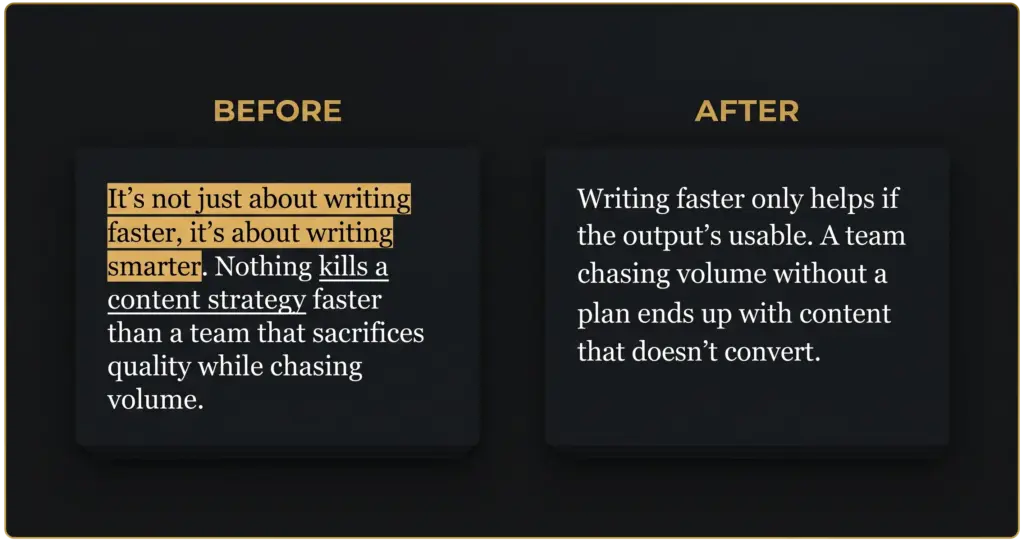
Here’s an unedited Claude paragraph on the same topic as this section, followed by the edited version, so the difference is visible rather than just described.
Before:
“It’s not just about writing faster, it’s about writing smarter. Nothing kills a content strategy faster than a team that sacrifices quality while chasing volume. Write without a plan, and the content falls flat. Write with a plan, and the content converts (targeting the right keywords, the right structure, and the right intent).”
After:
“Writing faster only helps if the output’s usable. A team chasing volume without a plan for keywords, structure, and intent ends up with content that doesn’t convert, no matter how much of it gets published.”
Four tells removed in one pass: the “it’s not X, it’s Y” opener, the abstract “kills a content strategy” framing, the mirrored good-bad pair, and the parenthetical list at the end folded into the sentence itself. The edited version is also six words shorter, cutting these patterns tends to tighten a piece rather than lengthen it.
Why Claude drafts this way in the first place
Worth understanding briefly, since it explains why “just ask it to sound more human” rarely works on its own. Models trained with heavy reinforcement from human feedback tend to converge on patterns that read as confident and persuasive in isolation, contrast pairs, rule-of-three lists, emphatic framing, because those patterns score well in the training process that shapes the model’s style. The problem isn’t that any one instance is bad writing, a single mirrored pair can land fine. The problem is density: an unedited draft uses these patterns constantly, and repetition is what turns a legitimate rhetorical technique into a recognisable tell.
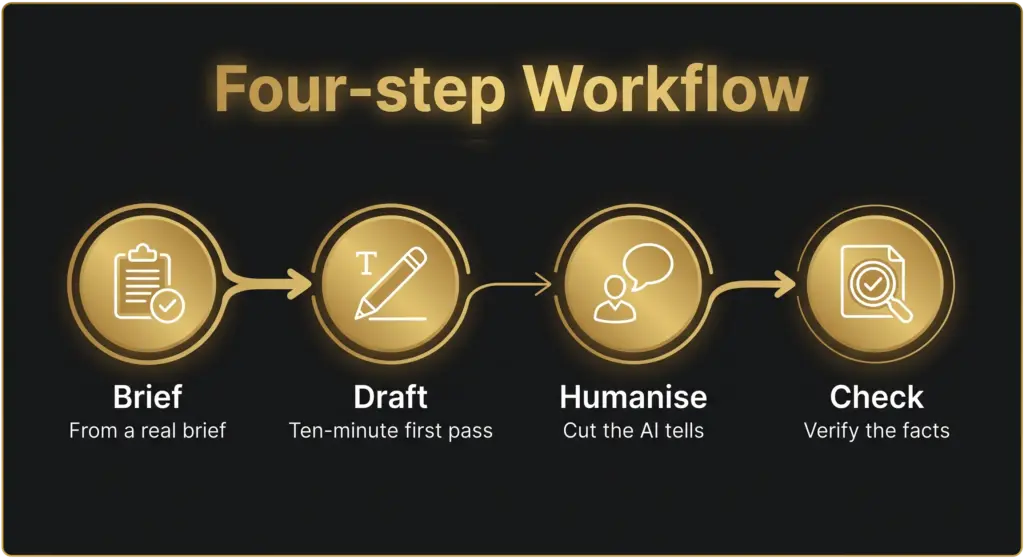
The workflow: brief, draft, edit, check
Brief. Start from an actual content brief, not a bare keyword. If you don’t have one yet, this is what the prompt library in this cluster Claude prompts for SEO keyword research and content briefs is built for.
Draft. Get Claude to write the first pass against that brief. Ten minutes, most of the way there structurally, not yet ready to publish.
Humanise. Run the draft against the seven tells above. Read it out loud if you can, sentences with a mirrored pair or a punchline rhythm tend to sound off the moment you hear them, even when they read fine silently.
Check. Verify anything presented as a fact, a statistic, or a claim about a real event. Claude can state something confidently and incorrectly, the same as any first draft from a junior writer, the check step exists precisely because “confident” and “correct” aren’t the same thing.
This isn’t a one-pass process for anything going out under a client’s name. A quicker internal note might only need the humanise step. A published article representing a brand needs all four, in order, every time, the same way a junior writer’s draft would get reviewed before it goes anywhere near a client.
What the humanise step actually looks like, line by line
Take a single sentence from a first draft and score it the way a real edit pass would: “This isn’t just another SEO tip, it’s a fundamental shift in how content gets made, and ignoring it means falling behind while everyone else races ahead.”
Run it against the list: it opens with an “it’s not X, it’s Y” construction, “fundamental shift” is an abstract noun doing emotional work instead of naming a real consequence, and “falling behind while everyone else races ahead” is a mirrored contrast pair restating the same warning twice. Three tells in one sentence, which is common in an unedited draft since the patterns tend to cluster.
Edited: “Ignore this and the content falls behind.” One clear claim, no restatement, no borrowed drama. That’s the actual mechanics of the humanise step, not a vague pass for “tone,” a specific check against a specific list, sentence by sentence.
Keeping brand voice consistent across writers
A lot of the humanising work above shrinks if the draft starts closer to on-brand in the first place. A Claude Project loaded with a brand’s past approved content and style notes produces a first draft that already sounds more like the account than a cold conversation would. That’s covered in full in Claude Skills and Projects for SEO Teams, worth setting up once the workflow above is second nature.
Running this against a real standard, not a vibe check
Here’s the part most “how to write with AI” content can’t say honestly: this entire cluster, this post included, gets produced against a documented internal standard with a named list of banned patterns and a pre-publish audit run on every single piece before it ships. It’s not a claim about intent, it’s the actual production process behind what you’re reading right now.
That’s a genuinely different starting point from “try to sound more human.” A checklist with named, specific failure patterns catches things a vague instinct misses, and it means the same standard applies whether one writer’s on an account or five. It also means a second person can check a piece against the same list a first person used, rather than two writers each applying their own vague sense of “good,” which is where quality usually starts drifting on a fast-growing account.
When not to use Claude for a piece
Worth being honest about the limit. Some content needs something Claude can’t truthfully generate: a founder’s actual opinion on a controversial call, a specific personal story with real details, anything resting on lived experience rather than pattern-matching from existing text. Claude can draft the structure around a real story once someone’s told it, it can’t invent the story itself and have it hold up as true.
There’s a simple test worth applying before you start: if the piece would fall apart the moment someone asked “did that actually happen,” it’s a Claude-assisted piece at best, with a real person supplying the actual substance. If it’s explaining a process, comparing options, or answering a question with a checkable answer, that’s exactly the kind of piece the workflow above is built for. Know which one you’re writing before you start, rather than finding out halfway through a draft that isn’t working.
Where this fits
Editing one piece well is a skill you can pick up from this page today. Doing it consistently, on every piece, for every client, on a deadline, without a documented standard behind it, is where quality drifts fast. If you’d rather have a team running this properly, that’s what our content marketing service is built for.
Not ready for that yet? Run your site through the free SEO & AI Visibility Audit first and see how your current content actually reads.
For the rest of the ways Claude fits into an SEO workflow, see the full guide: How to Use Claude for SEO
Sources cited
- Semrush Keyword Analytics: Claude AI content writing, Claude AI writing tool, US database, pulled 2026-07-28.
FAQ’S
What are the most common signs that content was written by AI?
Common tells include mirrored good-bad pairs (“skip the edit and it reads flat, do the edit and it reads real”), bracketed subtitles, “it’s not X, it’s Y” constructions, manufactured callout labels like “KEY INSIGHT:”, and parenthetical list-stuffing. Any one of these can appear in genuine writing occasionally, but density is what makes a draft recognisably AI-generated.
How can you fix a mirrored good-bad pair when editing AI content?
A mirrored good-bad pair restates the same point twice for effect, such as “Skip the edit, and it reads flat. Do the edit, and it reads real.” The fix is cutting it to one statement: “Skip the edit and it reads flat.” This removes the repetition without losing the meaning.
What four steps make up a workflow for turning a Claude draft into publishable content?
The workflow runs through four steps: start from an actual content brief rather than a bare keyword, get Claude to produce a first draft, humanise that draft by checking it against known AI writing tells, then check any facts or claims Claude has stated confidently. Skipping that last step is risky, since Claude can state something incorrect with full confidence.
What kind of content shouldn’t be written using Claude?
Content resting on lived experience rather than pattern-matching from existing text isn’t a good fit, such as a founder’s genuine opinion on a controversial decision or a personal story with real details. A useful test is asking whether the piece would fall apart if someone asked “did that actually happen?” If so, it needs a human writer.
How does a Claude Project help keep brand voice consistent across multiple writers?
Loading a Claude Project with a brand’s past approved content and style notes means each new draft starts closer to how the brand actually sounds, rather than beginning from a cold conversation. This matters most when several writers produce content for the same account, giving everyone a shared starting point instead of relying on individual interpretation.