


Most “AI prompts for SEO” lists are the same twenty generic prompts copied across a hundred blogs: “write a blog post about X,” “generate meta descriptions for Y.” None of them are built around what an SEO researcher actually spends their day doing.
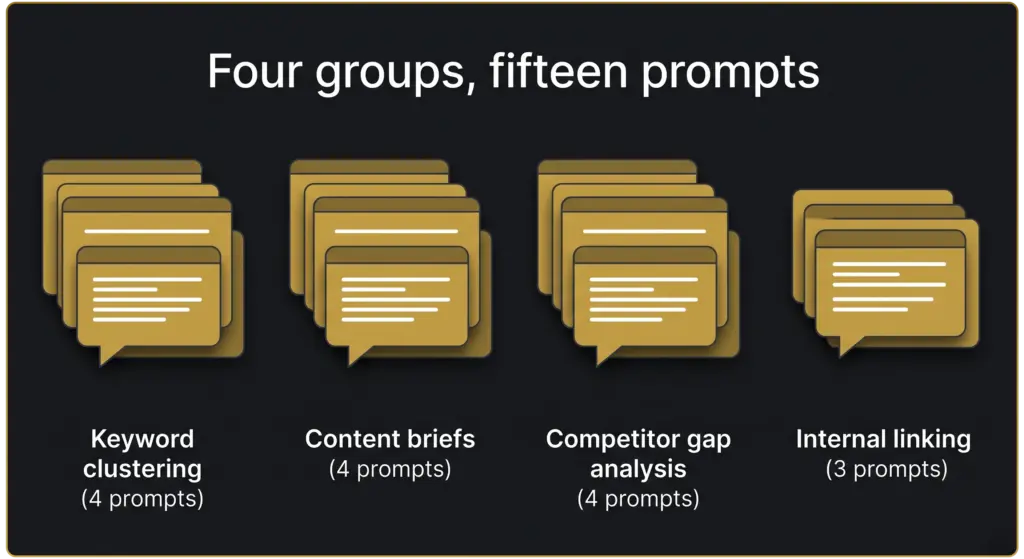
These 15 are grouped into four real jobs: clustering keywords, building content briefs, finding competitor gaps, and mapping internal links. Copy them, swap in your own details, and treat every output as a first draft, not a final answer. Claude doesn’t know your client’s business as well as you do, at least not until you’ve set it up with that context, which is worth doing if you’re running these regularly.
Keyword clustering
- Group by intent
Group this list of keywords into clusters by search intent (informational, commercial, transactional). For each cluster, name the theme and suggest one page type it should map to: [paste keyword list]
- Spot cannibalisation risk
Look at these keywords and flag any that are close enough in intent that they’d compete for the same page if I built separate content for each: [paste keyword list]
- Find the missing cluster
Here’s our current list of ranking keywords for [website/topic]. Based on this, what related keyword clusters are we probably missing that a competitor would cover? [paste list]
- Prioritise by funnel stage
Sort these keywords into top, middle, and bottom of funnel, then tell me which bottom-funnel cluster has the fewest existing pages targeting it: [paste keyword list]
Content briefs
- Build the skeleton
Build a content brief for the keyword “[keyword].” Include: search intent, a suggested H1, an H2/H3 outline, and three questions the article needs to answer to satisfy the reader.
- Reverse-engineer a competitor
Here’s the text of a top-ranking article for “[keyword]”: [paste text]. What does it cover well, and what’s a genuine gap I could fill without just padding the word count?
- Set the differentiation angle
Based on this brief [paste brief], suggest one honest angle that would make our version genuinely different from what’s already ranking, not just longer.
- Draft the questions section
For the keyword “[keyword],” list the real questions someone would still have after reading a decent article on this topic, the kind a “People Also Ask” box would show.
Competitor gap analysis
- Compare topic coverage
Compare these two pieces of content on [topic]: ours [paste] and a competitor’s [paste]. What does theirs cover that ours doesn’t, and does it actually matter to the reader?
- Spot outdated claims
Read this competitor article: [paste text]. Flag anything that reads as outdated, unsupported, or likely to be wrong by [current year].
- Find the citation-worthy gap
Based on this competitor’s article [paste text], what specific, checkable fact or example is missing that would make a piece more useful to cite than theirs?
- Audit their CTA
Look at how this competitor closes their article: [paste closing section]. What’s their call to action, and how could ours be more useful without being pushier?
Internal linking
- Suggest links from an existing page
Here’s a page on our site: [paste URL or text]. Based on its content, suggest three other pages on [domain] it should link to, and the anchor text for each.
- Find orphaned topics
Here’s a list of our published articles: [paste titles/URLs]. Which ones look like they aren’t linked from anywhere else on the list, based on the topics involved?
- Vary the anchor text
Here are five instances where we’ve linked to [target page] using the same anchor text: [paste examples]. Suggest natural alternatives that still make sense in context.
How to actually use these well
Feed Claude real context before you run these prompts, not just the prompt on its own. A Claude Project with the client’s past briefs, style guide, and previous audits loaded in gets noticeably better output than a cold conversation every time. That’s the difference between a generic answer and one that sounds like it actually knows the account, and it’s worth setting up if you’re running this workflow more than once for the same client.
None of these replace the judgment call on which cluster is worth the hours or which gap is worth filling. That’s still the job.
Running fifteen prompts across every client account, every week, is where this stops being a quick win and starts being a resourcing question. If you’d rather have a team handle keyword research and content briefs at scale, that’s what our content marketing service is built for.
Not ready for that yet? Run your site through the free SEO & AI Visibility Audit first and see where your content actually stands before you decide what to fix.
For the rest of the ways Claude fits into an SEO workflow, see the full guide: How to Use Claude for SEO
FAQ’S
What are the main categories of Claude prompts for SEO keyword research?
Claude prompts for SEO keyword research generally fall into four categories: keyword clustering, content briefs, competitor gap analysis, and internal linking. Grouping prompts this way covers the tasks a researcher handles daily, such as sorting keywords by intent, outlining briefs, finding content gaps, and linking related pages, rather than relying on generic prompts like “write a blog post about X.”
Why does giving Claude background context improve SEO prompt results?
Claude doesn’t know a client’s business, tone, or past work unless that context is provided first. Loading previous briefs, a style guide, and past audits into a Claude Project produces sharper, more relevant answers than a cold prompt. This is especially worth doing when running the same prompts regularly for one client.
How can Claude help spot keyword cannibalisation before content is written?
Claude can review a keyword list and flag terms close enough in intent that they’d compete for the same page. Checking this before writing new content helps avoid publishing pages that target overlapping search intent, which can dilute rankings. The output is a flag to investigate, not an automatic fix.
Can Claude’s keyword and content suggestions replace strategic SEO decision-making?
No. Claude can group keywords, draft brief skeletons, and highlight competitor gaps, but its outputs should be treated as first drafts. Deciding which cluster is worth pursuing, or which content gap is worth filling, still comes down to human judgement.
When does running AI SEO prompts manually stop being efficient for agencies?
Running many AI prompts across every client account every week stops being a quick win and becomes a resourcing problem, since each output still needs reviewing. At that scale, it often makes more sense to have a dedicated team handle keyword research and content briefs than to run prompts manually each week.
Sources cited
- Semrush Keyword Analytics: Claude prompts for SEO, Claude AI prompts, US database, pulled 2026-07-28.