


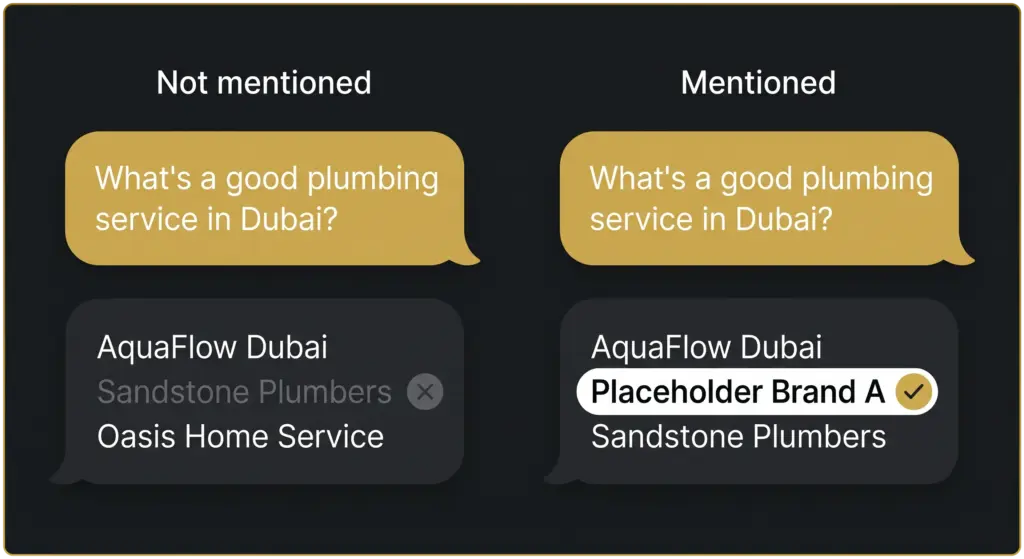
Ask Claude a question your business should show up in the answer to, and watch a competitor get named instead. That’s the moment this page is for. Everything else in this cluster is about using Claude as a tool, research, writing, audits, automation. This one flips it: when someone else asks Claude a question, does your brand even come up?
Worth being straight about this before anything else: nothing below guarantees a citation. Nobody outside Anthropic knows the exact weighting Claude puts on any single factor, and that weighting shifts as the model changes. What follows is a checklist of what’s actually known to help, built from how these systems are documented to work, not a formula that promises a result.
Why Claude cites some brands and not others
A few things are reasonably well understood here, and a few are more of an informed inference, worth being honest about which is which.
Fairly well established: Claude, like other AI systems that browse or retrieve web content, needs to actually read your page’s core content, and that means server-side rendering matters. If your business name, services, and location only appear once a script finishes loading in a browser, a crawler that doesn’t run that script the same way a person’s browser does may never see them. This is the same rendering issue covered in the technical side of this cluster, not a new problem, just a new reason it matters.
Reasonably well supported: unlinked brand mentions count for more here than they ever did in classic link-building. A local press write-up, a directory listing, a forum thread that names your business, none of it needs a link back to your site to matter for an AI system building a picture of what’s credible and current in a space.
A fair inference, not a confirmed rule: freshness matters, a page that looks actively maintained, with a real, visible update date, likely reads as more current and trustworthy than one that hasn’t changed in years. And having your business’s own description of what it does stated in plain, direct language, not just a slogan, gives a retrieval system less to guess at.
One more factor worth naming, borrowed from a much older discipline: consistency. Local SEO’s spent over a decade hammering on getting a business’s name, address, and phone number identical across every directory and listing, and that same logic carries over here. If your business is described one way on your own site and a slightly different way on a directory or review platform, that inconsistency doesn’t help a system trying to build a confident, single picture of who you are and what you do. An old idea, and one that turns out to still matter here.
What GEO actually means, and how it’s different from classic SEO
GEO, generative engine optimization, is the practice of making a brand more likely to be surfaced and cited inside AI-generated answers, as opposed to classic SEO, which optimizes for a ranked list of links a person clicks through themselves. You’ll also see the term answer engine optimization (AEO) used for very similar ground, most people use the two somewhat interchangeably, and the distinction matters less than getting either one right.
We’ve covered this territory before on this site, in more depth, in our dedicated [AEO playbook →], worth reading alongside this page rather than instead of it, since that piece goes deeper on the classic-SEO-versus-AEO distinction than this checklist has room for.
The GEO checklist for UAE businesses
This is the part that’s actually ownable for a Dubai-based agency writing this, rather than a US or UK consultancy repeating the same general framework everyone else already has. Run through these six, and be honest about which ones are actually true today, not which ones you plan to fix eventually.
- Your business’s name, service, and location are stated in plain, crawlable text somewhere on the site, not buried only in an image, a video, or an element that only renders after a script runs.
- Your core pages render fully without needing JavaScript to load the main content. Check this with a plain fetch of the page’s source, not just how it looks in a browser, since a browser runs the scripts a crawler might not.
- Structured data is in place and actually matches what’s on the page. A LocalBusiness or Organization schema that states your real name, location, and category gives a retrieval system a clean, structured answer instead of one it has to guess at from prose.
- Your brand gets a real mention, link or no link, on at least a few genuinely UAE-relevant sources, an industry directory, a piece of local press, a review platform people in this market actually use.
- Your pages carry a visible, honest update date, and the content behind that date actually changes. A stamped date that never moves is worse than no date at all.
- Your About page states plainly, in ordinary language, what the business does and who it’s for, not just a tagline that reads well but says nothing concrete.
If you can honestly tick two or fewer of these right now, that’s your actual starting point, not the other four. Most UAE businesses we’ve looked at land somewhere around there, it’s just where GEO work usually starts, not a sign something’s gone wrong.
A quick, hypothetical illustration of why this stacks up: picture two dental clinics in Business Bay, both genuinely good, both with real reviews. Clinic A’s site is a single-page JavaScript app with no schema and no mentions anywhere off-site beyond its own booking platform. Clinic B has plain, crawlable service pages, a LocalBusiness schema that matches what’s on the page, and a handful of real mentions on UAE health directories and a local lifestyle site. Nothing here guarantees Clinic B gets cited over Clinic A on any given query, but Clinic B has given a retrieval system considerably more to work with. That’s the whole logic behind this checklist, not a promised outcome, just better odds.
What this doesn’t guarantee
None of the six items above are a lever you pull once and forget. Models change how they select and weight sources over time, what mattered six months ago may matter less now, and what doesn’t matter yet may matter more later. Treat this checklist as something worth re-checking every few months, not a box ticked once and filed away. And even with all six genuinely true, there’s still no promise of a specific citation on a specific query, this improves the odds, it doesn’t fix them.
How this connects to the rest of this cluster
Two other pieces on this site sit close to this one, worth reading together rather than as three separate, disconnected posts on the same subject. Our ChatGPT vs Claude vs Gemini: Which AI Engine Actually Cites UAE Businesses? piece runs a live comparison of citation behaviour across the three engines, useful if you want to see how this plays out in practice rather than in principle. And the [AEO playbook →] referenced above goes deeper on the broader answer-engine-optimisation discipline this checklist sits inside.
If you’re earlier in the journey and want the fuller picture of how Claude fits into an SEO workflow generally, not just the citation side, start at our complete guide to using Claude for SEO.
Where this fits
The fastest way to know where you actually stand is to check, rather than guess your way down the checklist above. Run your site through the free SEO & AI Visibility Audit and see, concretely, whether your brand is showing up where it should be.
Once you know where the gaps are, that’s the point where fixing them properly, and keeping up with how the models keep changing, becomes a job worth handing to a team rather than a checklist you revisit once a quarter on your own. That’s what our AI SEO Dubai service is for.
FAQs
What does GEO mean in the context of Claude and AI search?
GEO stands for Generative Engine Optimization: the practice of making a brand more likely to be surfaced and cited inside AI-generated answers, rather than ranked in a list of links. It’s often used interchangeably with AEO (Answer Engine Optimization). Both focus on how AI tools construct answers, not just how pages rank on a search results page.
Why might a competitor get cited by Claude instead of your business?
Claude relies on crawlable text, so business details that only appear after scripts load can be missed entirely. Citation also favours brands with unlinked mentions in local press, directories, and forums, consistent business details across platforms, and pages with visible update dates. A competitor doing these things consistently is simply giving Claude more to work with.
Does having consistent NAP (name, address, phone) details help AI citation?
Yes. Matching your business name, address, and phone number across all platforms, a long-standing local SEO practice, remains relevant for AI systems building unified brand profiles from multiple sources. Inconsistent details across your website, directories, and review platforms make it harder for Claude to confirm which information is accurate and trustworthy enough to cite.
Does following GEO best practices guarantee your brand will be cited by Claude?
No. Nothing guarantees citation, since nobody outside Anthropic knows Claude’s exact weighting factors. Practices like crawlable content, accurate schema, and genuine off-site mentions only improve the odds. Model weighting also changes over time, so these factors are worth rechecking every few months rather than treated as a one-off fix.
Why does structured data need to match visible page content for AI citation?
Structured data such as LocalBusiness or Organization schema should match page content exactly, since mismatched or inflated schema signals unreliable information. Combined with plain-language business descriptions and visible update dates, accurate schema gives AI retrieval systems clearer signals when deciding whether a page is trustworthy enough to cite.