



The Visibility Shift That Most Brands Still Misunderstand
Search visibility is no longer defined by where a page ranks or how many clicks it attracts. In 2026, the real battleground is whether your brand is recognised, referenced, or trusted by AI systems that increasingly sit between users and the open web.
Tools such as ChatGPT, Google’s AI Overviews, Gemini and Copilot now answer a growing share of commercial, informational and advisory queries directly. Instead of sending users to ten blue links, they summarise, compare and explain. Brands are no longer competing purely for traffic. They are competing to be included, accurately represented or excluded entirely from those answers.
This shift is closely connected to the rise of What Is Generative Engine Optimisation (GEO)? a framework focused on optimising content for inclusion, citation and representation within AI-generated responses rather than traditional SERP positions alone.
In many cases, this visibility happens without a visit. A business can shape perception, influence decisions and still see no corresponding session in analytics. For companies relying on rankings and click-through rates alone, this shift creates a blind spot that traditional reporting does not capture, which is why many teams are now looking at the best tools for AI visibility to understand where their brand shows up in generated answers.
For brands operating across GCC markets, the implications are sharper. Trust, authority and reputation already play an outsized role in how decisions are made in sectors such as finance, property, legal services and healthcare. When AI systems become the first point of explanation, absence is not just a missed optimisation opportunity. It is a reputational gap.
Understanding how AI models decide what to trust is now a strategic requirement, not a technical curiosity.
How ChatGPT Decides What It Can Trust
1. What ‘Trust’ Actually Means in AI Search
In AI-driven search, trust isn’t a proxy for popularity. High traffic, large audiences or frequent mentions do not automatically make a source reliable from a model’s perspective. In some cases, widely cited brands with inconsistent messaging are harder for AI systems to rely on than smaller organisations that communicate with precision.
Trust, in this context, is built from four attributes working together:
- Consistency: A stable narrative about who you are and what you do across the web
- Corroboration: Independent sources reinforcing the same facts
- Clarity: Information that can be understood without inference or interpretation
- Authority: Repeated presence in credible, relevant environments
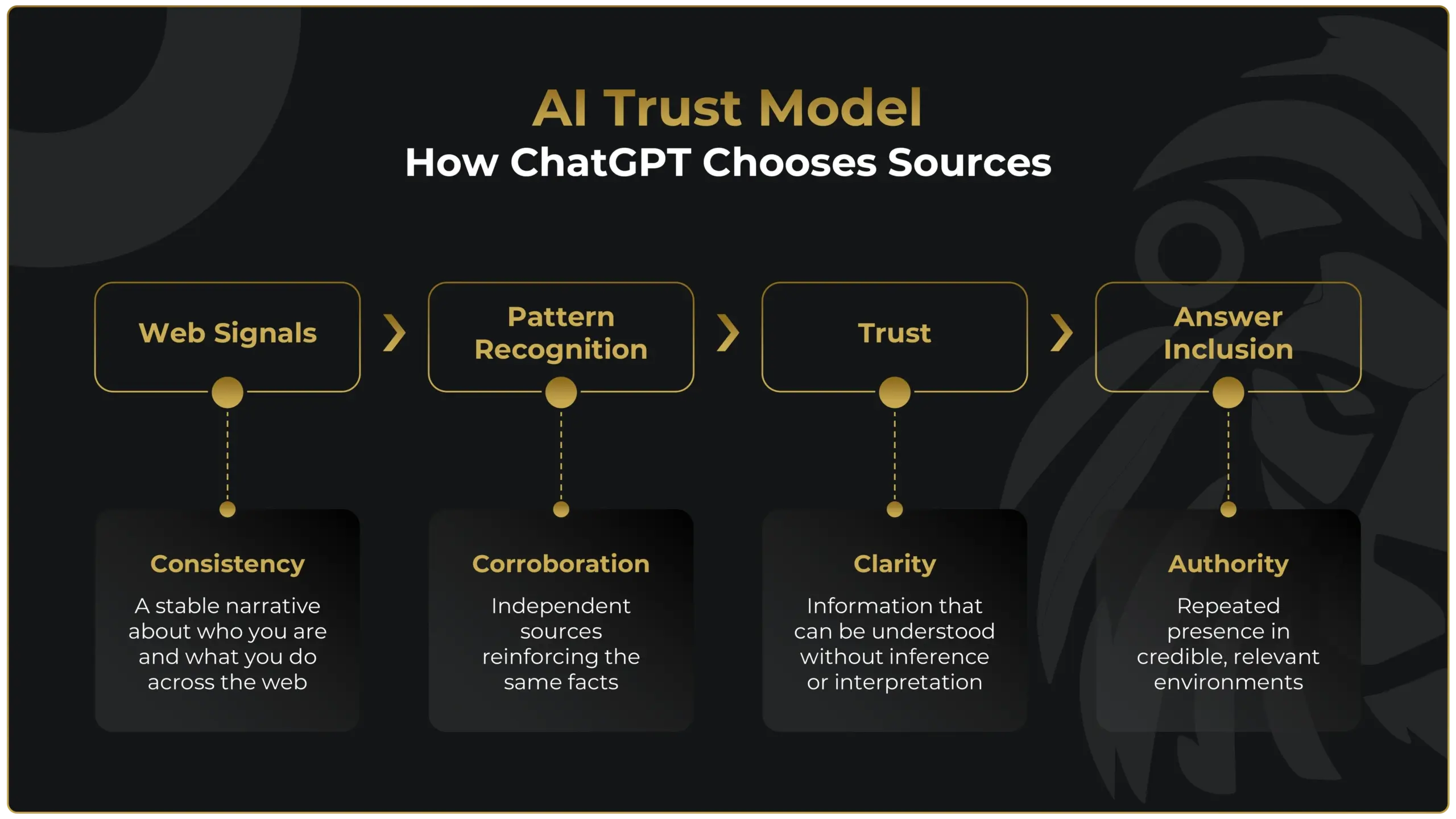
Rather than evaluating individual pages in isolation, models synthesise meaning from patterns across the open web. They look for alignment over time, not one-off optimisation wins. The more coherent and predictable those patterns are, the easier it is for an AI system to treat a source as dependable.
2.Core Trust Signals (Explained Practically)
It’s more useful to think of AI trust inputs as signals, not ranking factors. These signals help models reduce uncertainty when generating answers.
The most influential signals tend to be:
- Entity clarity: Clear definition of who you are, what you offer and where you operate
- Repetition across credible sources: Consistent descriptions appearing in independent publications
- Language consistency: Stable terminology and positioning across pages, platforms and media
- Factual stability over time: Core claims and explanations that do not shift frequently
- Clear topical boundaries: A defined area of expertise rather than broad, unfocused coverage
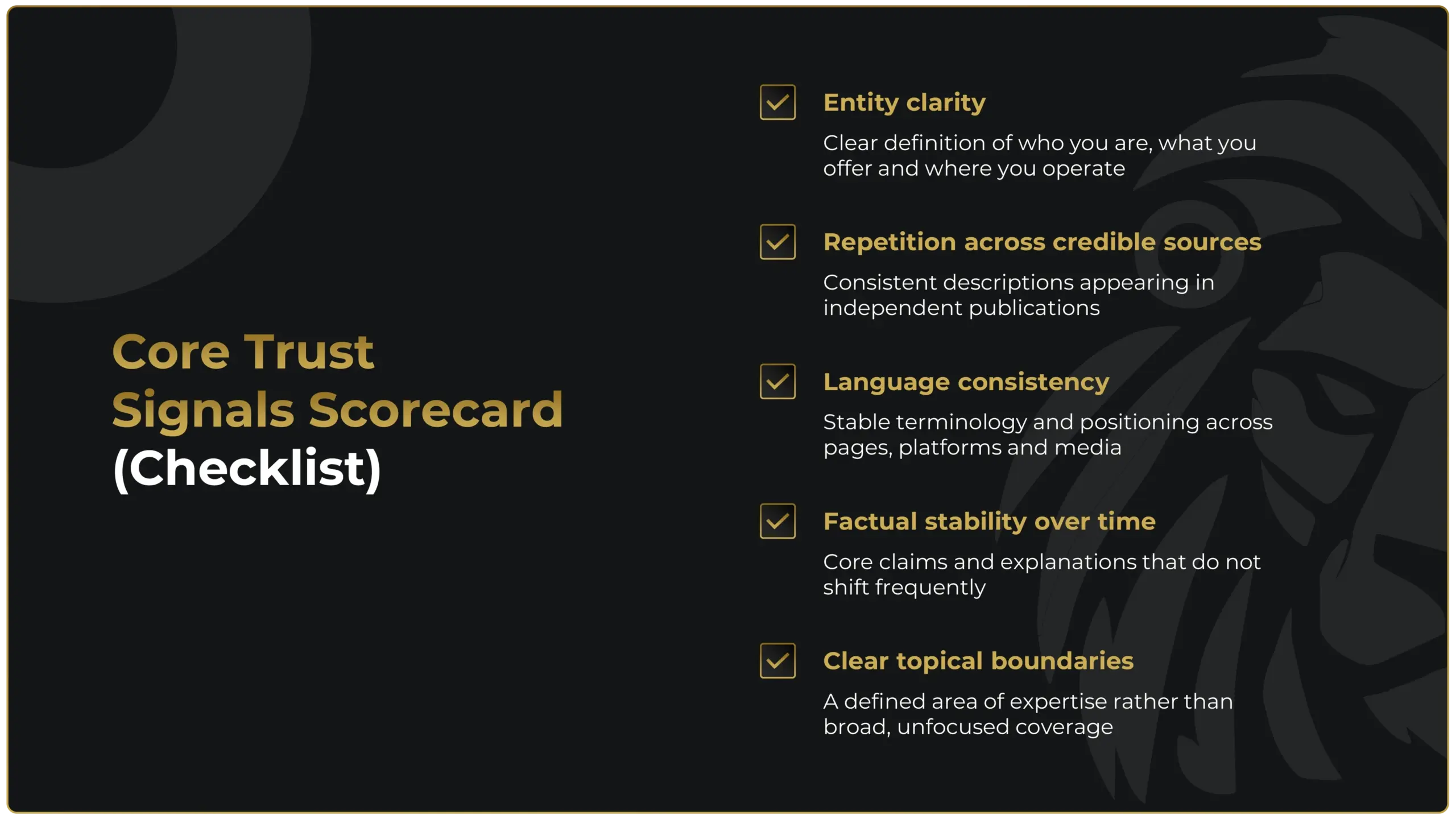
When these signals are weak or contradictory, models struggle to form a reliable understanding. When they are strong and aligned, trust becomes easier to establish, even without scale.
3. Why This Is Different From Traditional SEO
These trust mechanics diverge sharply from traditional SEO logic. There is no keyword matching in the classic sense and far less emphasis on freshness for its own sake. Reliability carries more weight than recency, which changes how content needs to be structured and repeated across the web.
AI systems prefer sources they can summarise cleanly. Precise content, internally consistent and free from exaggerated claims, is easier to compress into an accurate answer. In practice, optimisation shifts away from chasing rankings and towards being understood correctly and consistently across the web, including the added complexity of Arabic & English SEO, where mismatched terminology or naming across languages can fragment entity signals and reduce trust.
Entity-First SEO, The Foundation of AI Visibility
1. From Pages to Entities
Traditional SEO has conditioned businesses to think in pages, URLs and keywords. AI-driven search works differently. Google and large language models don’t primarily organise information by web pages. They organise it by entities.
An entity is a clearly defined ‘thing’ that can be understood, referenced and connected to other things. Brands, people, locations, products and organisations are all entities. Pages are simply one of many sources used to describe them.
This distinction matters. If an AI system understands your entity clearly, it can reference you accurately even if it never sends a user to your site. If it doesn’t, your content becomes fragmented, no matter how well optimised individual pages appear to be.
At an entity level, the question isn’t ‘does this page rank?’ but ‘does the web describe this business consistently enough for a model to understand it without confusion?’
If the answer is no, visibility becomes unreliable by default.
2. Entity Signals That Matter in 2026
Entity clarity is reinforced through a small number of practical, observable signals. The most important ones include:
- Consistent brand naming: The same business name used across websites, media, directories and profiles
- Clear service and sector definitions: A stable explanation of what you do and which market you operate in
- Geographic precision: Clear association with specific countries, cities or regions, which is critical in GCC markets
- Author and leadership attribution: Identifiable people linked to the business and its expertise
- Schema as clarification, not decoration: Structured data used to reduce ambiguity, not to game results
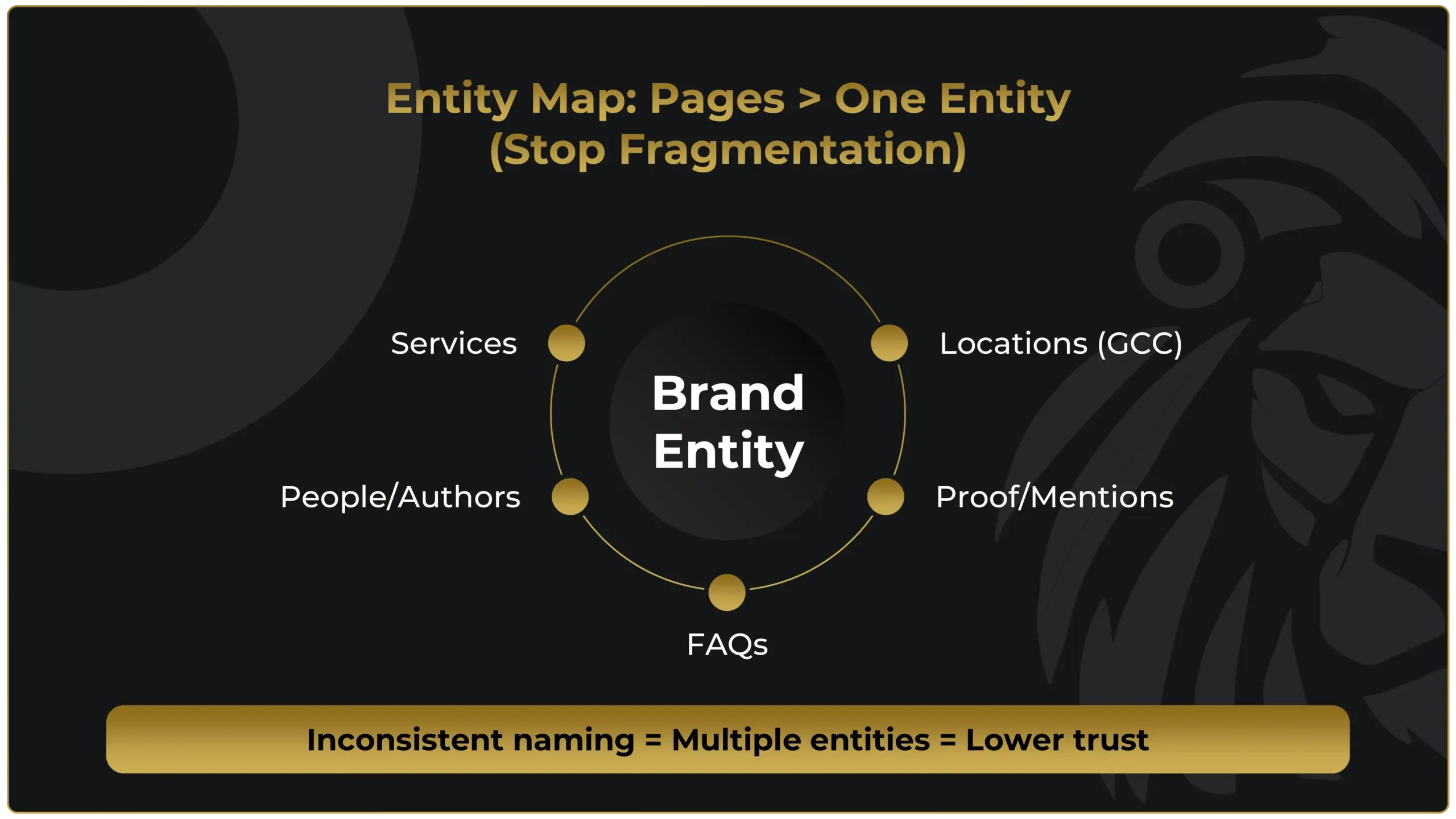
When these signals align, AI systems can form a coherent picture. When they don’t, models are forced to infer, and inference is where trust breaks down.
3. GCC-Specific Entity Challenges
Entity clarity is often harder to achieve in GCC markets due to structural complexity. Common challenges include:
- Multilingual environments: Arabic and English content describing the same entity differently
- Transliteration inconsistencies: Multiple spellings of the same brand or name across platforms
- Free-zone vs mainland naming: Legal names that differ from public-facing brands
- Group brands and holding structures: Multiple entities operating under overlapping identities
Without deliberate entity management, these issues fragment visibility. In AI-driven search, fragmentation is not neutral. It actively reduces the likelihood of being referenced at all.
Why Being ‘Good at SEO’ Is No Longer Enough
1. The Decline of Click-Based Visibility
For most of SEO’s history, success was measured by clicks. Higher rankings led to more traffic, and more traffic implied greater influence. That relationship has been weakening for years and AI has accelerated the break.
Several forces are converging:
- Declining organic CTR: As search results pages become more crowded, fewer users click through
- Rise of zero-click answers: Users increasingly get what they need without leaving the results
- AI summaries absorbing intent early: Questions are answered before a visit ever becomes necessary
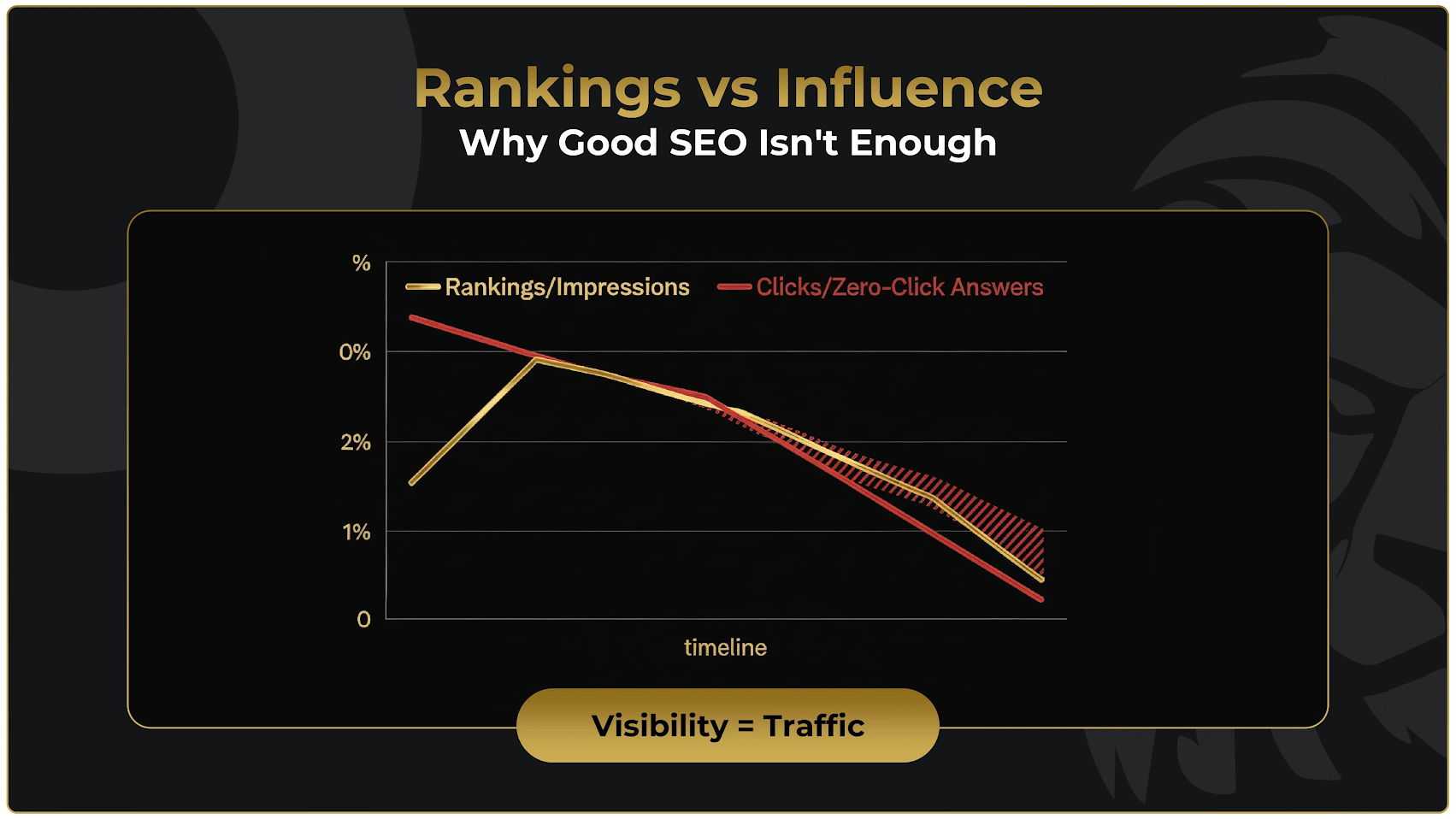
Research from Google, SparkToro and Similarweb has consistently shown that a majority of searches now end without a click. AI-driven answers push this further by resolving intent at the explanation stage, not the exploration stage.
2. Visibility Without Traffic Is Still Visibility
The absence of a click doesn’t mean the absence of influence. When a brand is mentioned, cited or referenced inside an AI-generated answer, it still shapes perception.
This matters most in high-consideration sectors, where users are seeking reassurance rather than immediacy:
- Finance and wealth management
- Property and real estate investment
- Legal and professional services
- Healthcare
- B2B services
Across UAE and Saudi buyer journeys in particular, AI answers often act as a first filter. They narrow options, establish credibility and frame expectations long before any direct enquiry or website visit occurs.
3. Measuring Presence Instead of Position
Rankings alone no longer reflect influence. A business can rank well and still be absent from AI answers that shape real decisions.
This has shifted the focus from position to presence. The relevant question becomes whether a brand appears consistently and accurately when AI systems explain a topic. Some organisations now track this using dedicated measurement approaches, including analysis via a free AI visibility tool, which highlights how often brands surface in AI-generated responses even when no traffic is recorded.
In an AI-first environment, being visible but unclicked can still be strategically valuable. Being absent is not.
Content That Models Can Reliably Summarise
1. Why AI Prefers Certain Content Structures
AI systems aren’t looking for creativity or persuasion. They’re looking for material they can interpret, compress and restate with confidence. Content that performs well in AI answers tends to share a small number of structural characteristics:
- Clear explanations: Ideas are expressed directly, without unnecessary framing or storytelling
- Neutral tone: Information is presented without hype, emotion or exaggerated claims
- Definitive statements backed by evidence: Assertions are supported by facts, not implication
- Low ambiguity: Language leaves little room for misinterpretation
From a model’s perspective, this type of content reduces risk. It can be summarised without needing caveats, qualifiers or contextual guesswork. The easier it is to extract meaning, the more likely it is to be reused.
2. What Breaks Trust
Just as some structures enable trust, others actively undermine it. Common trust breakers include:
- Over-optimised copy: Content written to signal SEO intent rather than convey understanding
- Sales language: Promotional phrasing that prioritises persuasion over explanation
- Vague positioning: Unclear descriptions of services, expertise or scope
- Contradictory messaging across pages: Different claims or definitions appearing in different places
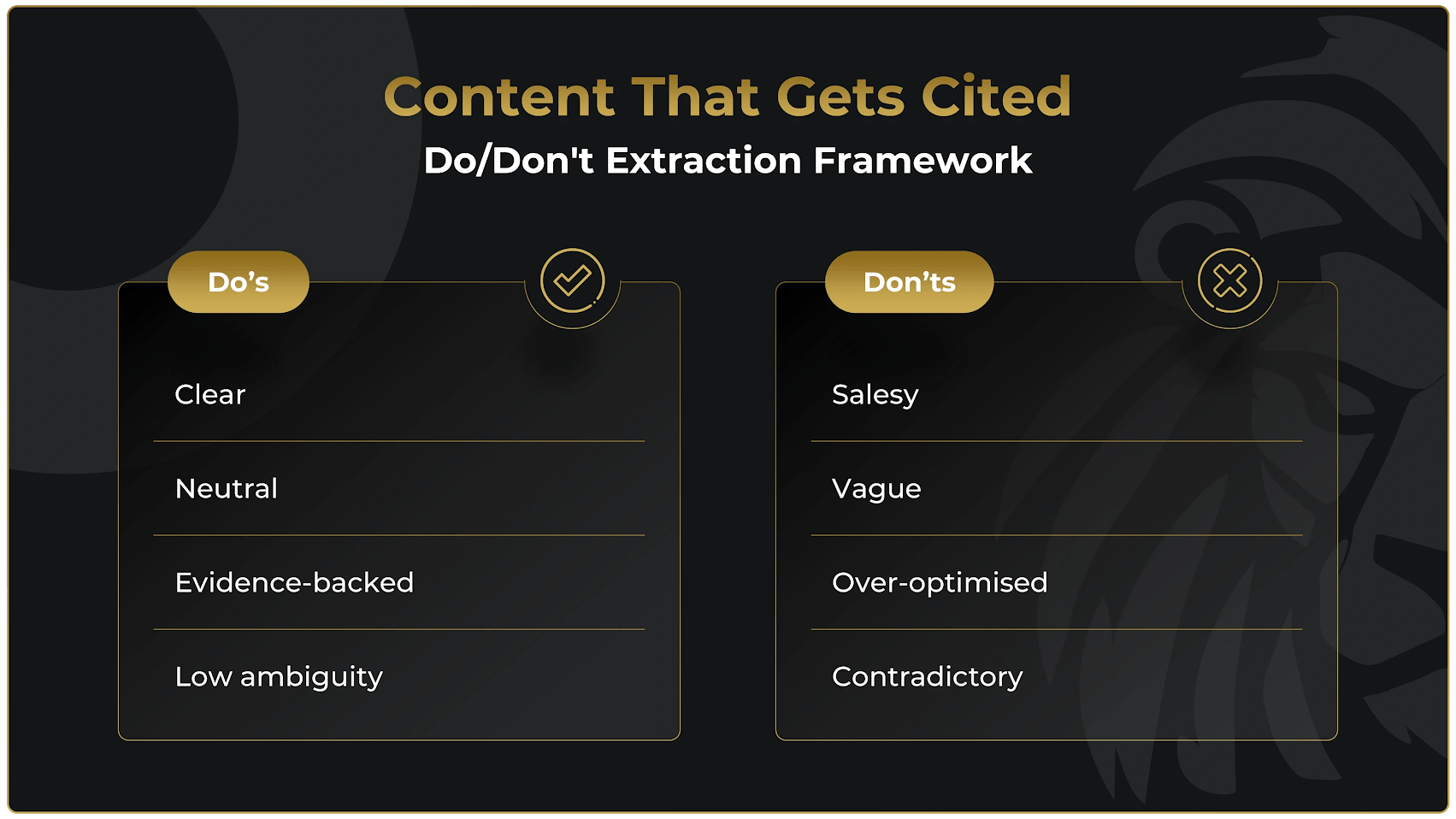
When models encounter these patterns, they struggle to form a stable interpretation. The result is often exclusion rather than misrepresentation.
3. Editorial Style Over Marketing Style
Content that performs well in AI-driven environments is closer to editorial writing than marketing copy. It’s written to explain, not convert. It answers real questions directly, without padding. Structure is used to support extraction, not engagement metrics.
As AI systems increasingly act as interpreters, clarity becomes more valuable than cleverness. Brands that adopt an editorial mindset make it easier for models to trust and reuse their content accurately.
Authority Is Built Off-Site Before It Is Reflected On-Site
1. Mentions Matter More Than Links Alone
For years, authority was reduced to backlinks. While links still matter, AI systems look beyond them. Models ingest citations, references and contextual mentions across the open web, not just hyperlinks pointing back to a domain.
A brand mentioned repeatedly in credible, relevant contexts becomes easier for an AI system to trust, even if those mentions are not technically ‘links’. What matters is how often a business is referenced as part of an explanation, comparison or expert viewpoint. Context reinforces meaning. Volume without relevance does not.
From an AI perspective, a clean, consistent mention in a respected publication often carries more weight than dozens of low-context links elsewhere.
2. Digital PR and Brand Consistency
This is where digital PR intersects directly with AI visibility. Authority is reinforced when a brand appears in places where explanation and interpretation matter.
The most effective signals tend to come from:
- Industry commentary: Expert perspectives that explain markets, trends or risks
- Founder insights: Identifiable individuals consistently associated with the business and its expertise
- Neutral third-party references: Coverage where the brand is referenced, not promoted
Consistency is critical. If different publications describe the same business in conflicting ways, trust erodes. When descriptions align, models gain confidence in reusing that information.
3. Regional Authority in GCC Markets
In GCC markets, authority is often local before it is global. Regional credibility carries disproportionate influence.
Signals that matter include:
- Local media credibility: Established outlets with regional trust
- Regional business publications: Sector-relevant coverage within GCC markets
- Sector-specific trust signals: Appearances in industry-aligned environments
For AI systems, these regional signals help anchor an entity geographically and culturally. Authority built off-site in the right contexts is what ultimately allows on-site content to be trusted and reused.
The Role of Technical SEO in AI Trust
1. Technical Clarity Enables Interpretation
Technical SEO no longer wins visibility on its own, but it still determines whether a brand can be interpreted accurately. Crawlability remains foundational. If key pages cannot be accessed or understood reliably, everything built on top becomes fragile.
Clean site architecture plays a similar role. Logical structures help both search engines and AI systems understand how information is organised and which pages represent core definitions versus supporting details. Proper canonicalisation is equally important. When multiple versions of the same content exist without clear signals, models are forced to reconcile conflicts that should never exist in the first place.
Technical clarity doesn’t create trust. It allows trust to form.
2. Structured Data as Context, Not Manipulation
Structured data works best when it reduces ambiguity rather than attempts to influence outcomes. A schema helps clarify relationships between organisations, people, locations and services. It provides context, not persuasion.
This is particularly important for entities. Clear markup around organisations, leadership and geography makes it easier for AI systems to interpret information consistently. Used well, structured data supports understanding. Used aggressively, it introduces noise.
3. Why Poor Technical Foundations Undermine Trust
Weak technical foundations introduce friction that erodes confidence. Common issues include conflicting signals between pages, duplicate entities created by inconsistent URLs and inconsistent brand references across the site. These problems don’t always cause immediate failure, but they make reliable interpretation harder. In AI-driven search, uncertainty is rarely rewarded.
Closing Section: The Quiet Advantage of Being Understood
The competitive advantage emerging in AI-driven search is not speed, scale or novelty. It is being understood. Brands that communicate with clarity, consistency and restraint give AI systems less to guess and more to trust.
This advantage compounds quietly. Each consistent mention, clear definition and stable signal reinforces the next. Over time, trusted sources become the default reference models draw on when explaining a topic. Others fade from view without any obvious penalty or warning.
For businesses operating in GCC markets, where credibility often precedes engagement, this shift is especially consequential. Visibility is no longer about being louder than competitors. It is about being clearer than they are. In practice, that often means investing in a tailored SEO service that prioritises entity clarity, consistent messaging and technical hygiene rather than chasing short-term rankings.
As AI increasingly mediates how information is interpreted, trust is not earned through optimisation tricks. It is earned by removing ambiguity wherever it exists. For organisations specifically focused on earning visibility inside AI answers, this is increasingly being addressed through LLMO & GEO services in Dubai, where the goal is not more content, but more consistent, machine-readable credibility.

Global Usage & Market Share
ChatGPT adoption & activity
- ChatGPT processes ~2.5 billion prompts per day as of mid-2025, up from ~1 billion just months earlier — highlighting rapid growth in how users rely on AI for search-like tasks.
- ChatGPT holds ~80–81% of the global AI chatbot market share, far above competitors like Perplexity and Copilot.
- It remains one of the most visited websites globally, with ~5.7 billion monthly visits and ~800 million weekly active users.
Search & Visibility Trends
AI in search behavior
- AI Overviews appear in ~18% of global Google searches, embedding generative answers across informational queries.
- Queries that trigger AI results are predominantly informational (88%) and often longer (8+ words), signalling stronger intent for detailed answers. Exposure Ninja
- Over half of Google searches now end without a click — a major shift from traditional search habits.
ChatGPT and content overlap
- Only about 12% of ChatGPT’s cited URLs also rank in Google’s top 10 search results, and ~80% of those citations come from pages not ranking in Google’s top 100.
- Nearly 28.3% of ChatGPT’s most cited pages have zero organic visibility in traditional search, emphasising how AI visibility can be independent of SERP presence.
Conversion & Traffic Insights
AI search vs traditional search
- AI-driven visitors tend to convert at higher rates than traditional search — some studies show AI visitors converting 4–5× better on average. rankscience.com
- AI referral traffic is still small (under 1% of overall web traffic) but growing, and some projections anticipate AI search could account for 5–10% of web traffic by 2028.
Industry & Query Patterns
Sector-specific AI visibility
- The highest share of AI Overviews appears in categories such as Science (43.6%), Health (43.0%), Pets & Animals (36.8%) and People & Society (35.3%), showing stronger generative coverage in broad knowledge areas.
- Lower AI Overview frequency is found in Shopping (3.2%), Real Estate (5.8%) and Sports (14.8%).
Query characteristics
- Longer, conversational queries (8+ words) are more likely to trigger generative answers — a critical signal for how AI platforms interpret intent.
GCC & Regional Insights (Inferred Trends)
Note: There are no definitive GCC-specific global statistics yet published, but current data and regional adoption trends indicate:
- AI and conversational search adoption is rising quickly in UAE, Saudi and GCC markets, particularly among tech-savvy, mobile-first populations.
- Voice and conversational queries (natural language questions) are increasingly part of discovery behaviour — a pattern that aligns with AI adoption in multilingual contexts like GCC.
- Brands in regionally resonant sectors (finance, healthcare, property) are likely to see higher utility from AI visibility due to complex customer decisions that AI answers directly support.
Key Takeaways (Numbers That Matter)
ChatGPT & AI Visibility by Industry (GCC-Relevant)
Important context: There is no official ‘ChatGPT visibility by country’ dataset yet. What follows combines measured AI-search behaviour globally with sector demand patterns dominant in GCC markets. This is how serious analysts are approaching it in 2026.
Industries Most Likely to Appear in AI Answers
| Industry | AI Answer Presence | Why It Performs Well |
| Finance & Wealth | Very High | Explanatory queries, trust-led decisions, regulation questions |
| Real Estate & Property | High | Comparison-driven, long consideration cycles |
| Legal & Professional Services | High | Users ask ‘how’, ‘can I’, ‘what does it mean’ |
| Healthcare | Very High | Informational, risk-averse, clarity-driven |
| B2B Services | High | AI used as pre-sales filter |
| E-commerce / Retail | Low | Transactional intent still dominates |
| Hospitality & Travel | Medium | Mixed intent, discovery + booking |
Supporting global data:
AI Overviews and generative answers appear most often in Health, Science, Finance, People & Society categories (Google, SparkToro, Similarweb).
GCC-Specific Demand Signals (What Users Actually Ask AI)
Across UAE and Saudi Arabia, AI usage skews heavily toward decision support, not browsing.
Most Common AI Query Types in GCC Markets
- ‘Is this legal in the UAE / Saudi Arabia?’
- ‘What is the safest way to invest in…’
- ‘How does this work in Dubai / KSA?’
- ‘Which option is better for my situation?’
- ‘What are the risks of…?’
These queries favour explanation, comparison and authority, which is why AI visibility matters more than traffic in the region.
AI Visibility vs Google Rankings (Critical Stat)
This is the stat most people miss:
- ~80% of URLs cited by ChatGPT do NOT rank in Google’s top 100 results
- ~28% of cited pages have near-zero organic traffic
Implication for GCC brands:
You can be invisible in Google and still shape perception via AI answers.
Zero-Click Reality (Why GSC Data Is Misleading)
- Over 50% of searches now end without a click (Google, SparkToro)
- AI answers accelerate this by resolving intent early
- Google Search Console does not show:
- AI citations
- Brand mentions in AI summaries
- Influence without traffic
This is why many GCC brands believe ‘AI isn’t sending traffic’ while still losing ground in perception.
Where ChatGPT Visibility Is Most Valuable in GCC
| Sector | Visibility Value | Reason |
| Wealth / Private Finance | Very High | Trust precedes contact |
| Property Investment | Very High | AI narrows options early |
| Legal / Compliance | Very High | Users seek reassurance |
| Healthcare | Very High | Explanation > browsing |
| Corporate Services | High | AI acts as first advisor |
| Retail / DTC | Low | AI rarely completes purchase |
How AI Visibility Compounds (Observed Pattern)
Measured across multiple markets:
- Brand appears once in AI answers
- Model reuses that source for similar queries
- Entity becomes ‘default explanation’
- Competitors disappear without penalty
This compounding effect is slow but asymmetric. Once a model trusts a source, displacement is difficult.
FAQs on ChatGPT SEO in 2026
Does ChatGPT use Google rankings?
ChatGPT does not read Google rankings directly. It is influenced by information patterns across the open web, which may overlap with what ranks well in search. Rankings can correlate with visibility, but they are not a direct input.
Can small or regional brands appear in AI answers?
Yes. If a brand has clear entity definitions and consistent authority signals, size is not a barrier. AI systems prioritise clarity and reliability over brand scale.
Is Arabic content treated differently from English?
Arabic and English content are processed separately, but both contribute to overall entity understanding. Inconsistent translations or naming can fragment visibility. Alignment across languages improves trust.
How long does it take to become a trusted source?
Trust develops over months, not weeks. It requires repeated, consistent signals across multiple credible sources. There is no shortcut without compromising reliability.
Is AI visibility measurable today?
Yes, but measurement focuses on presence rather than traffic. The key indicator is whether a brand appears accurately in AI-generated answers, not how many clicks it receives.